
How-To Guide: Selecting and Using PVC Blending Resins for Optimal Performance and Cost Efficiency
How-To Guide: Selecting and Using PVC Blending Resins for Optimal Performance and Cost Efficiency
This guide provides industrial buyers and formulators with practical steps for selecting and incorporating PVC blending resins into their formulations. Blending resins, also known as extender or viscosity-reducing resins, are medium-molecular-weight PVC powders used to modify the rheology and properties of PVC plastisols and dry blends. Proper selection and use can lead to significant cost savings and performance enhancements.
Step 1: Define Your Primary Objective
Blending resins serve different primary functions. Your selection should be based on the most critical need for your specific application and process.
- Viscosity Reduction: The primary function for most applications. Blending resins lower the initial viscosity of PVC plastisols, improving flow, coating, and processing characteristics. This can reduce plasticizer demand by 10-20%.
- Cost Reduction: Used to partially replace more expensive paste resins (P-PVC) in formulations while maintaining key properties.
- Matting Effect: Certain grades provide a uniform matte finish to end products without additional matting agents.
- Mechanical Property Enhancement: Some resins can improve tensile strength, tear resistance, and impact resistance of the final product.
Step 2: Evaluate Key Technical Parameters
Compare supplier specifications against your process requirements. Key parameters include:
| Parameter | Typical Range | Impact on Formulation |
|---|---|---|
| K-Value / Degree of Polymerization (DP) | K-Value: 62-68 / DP: ~850-1100 | Lower K-value/DP generally correlates with better viscosity reduction and lower gelation temperature. |
| Particle Size & Distribution | Average: 20-40 μm (Medium Powder) | Affects dispersion, paste stability, and surface finish. Narrow distribution ensures consistent performance. |
| Apparent Density | 0.45 - 0.60 g/cm³ | Influences handling, mixing, and volumetric feeding in automated systems. |
| Volatile Matter | ≤ 0.4 - 0.5% | Lower moisture content improves paste stability and reduces defects like bubbles or pinholes. |
For example, the blend resin powder model SB-100C has a polymerization degree of 850-1100 (K value 62-67), an average particle diameter of 20μm, and an apparent density of 0.50-0.55 g/cm³. It is noted for its significant viscosity reduction effect and excellent matting performance.
Step 3: Consider Supplier Capabilities and Compliance
Partner with suppliers who can ensure material consistency and regulatory compliance, which is critical for global supply chains.
As a distributor and solution provider, they integrate product technology R&D and environmental safety testing. Their risk control measures include environmental safety testing on materials and ensuring traceability of raw material sources. Their in-house testing laboratory conducts checks on every batch of incoming materials for substances like phthalates, heavy metals, and compliance with RoHS and REACH regulations.
The company operates with a monthly sales capacity of approximately 4,000 tons and maintains a 20,000 m² self-built warehouse with a safety stock of over 3 months for bulk European materials to mitigate supply chain risks.
Compliance risks are addressed through testing for RoHS, REACH, and other environmental safety regulations on all incoming material batches. This is a critical step for manufacturers supplying to markets with strict safety standards, such as toys, food contact, and medical products.
Step 4: Pilot Testing and Formulation Adjustment
Before full-scale production, conduct lab-scale and pilot trials.
- Start with Recommended Ratios: A typical starting point is a blend of 20-30% blending resin with 70-80% primary paste resin. Adjust based on viscosity and property targets.
- Monitor Viscosity Profile: Measure initial viscosity and aging stability over 24-72 hours. A quality blending resin should provide stable viscosity over time.
- Check Compatibility: Ensure the blending resin is compatible with your specific plasticizer system (e.g., DINCH, DOTP, ATBC) and stabilizers (e.g., phenol-free Ca/Zn).
- Evaluate End-Product Properties: Test the mechanical properties, surface finish, and thermal stability of the final cured or molded product.
Step 5: Integration into Production and Cost Analysis
Once the formulation is optimized, plan for production-scale integration.
- Mixing Procedure: Ensure adequate shear and mixing time to fully disperse the blending resin powder into the plastisol. Inhomogeneous mixing can lead to performance inconsistencies.
- Cost-Benefit Calculation: Calculate the net savings. While the blending resin has a cost, it reduces the required amount of higher-cost paste resin and may reduce plasticizer consumption. Factor in potential improvements in processing speed and defect reduction.
- Quality Control: Establish incoming QC checks for the blending resin (e.g., moisture content, whiteness) and in-process checks for paste viscosity.
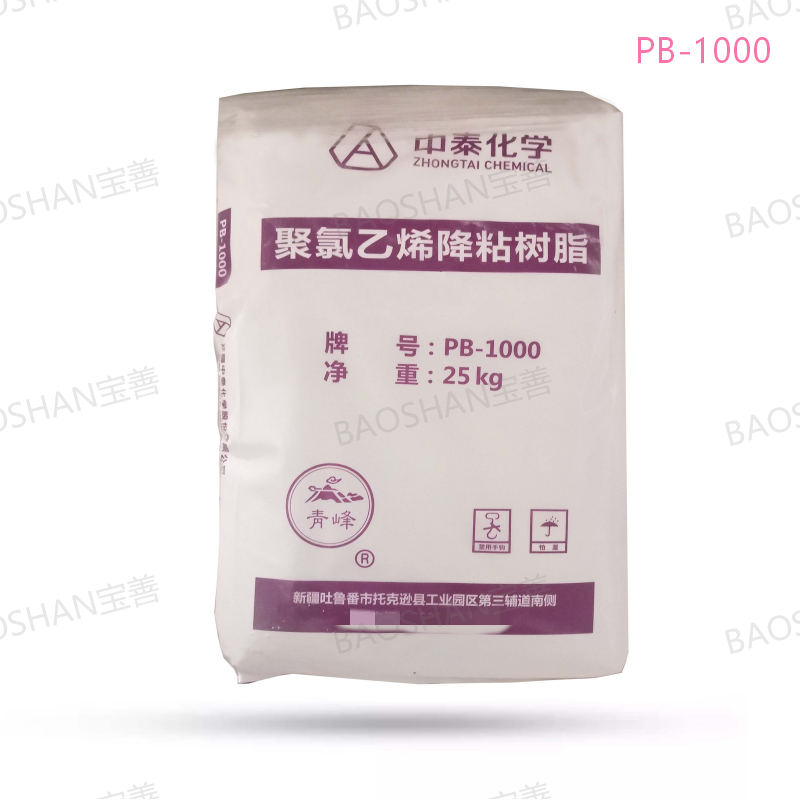
For instance, using a blending resin like Zhongtai PB-1000 or Kaneka PBM-B5F can offer cost-effective modification, with significant viscosity reduction achieved at a recommended dosage of 20–30%.
Common Application Processes for Blending Resins
Blending resins are versatile and used across several PVC processing methods:
- Coating Processes: Artificial leather, floor leather, wall coverings, coated fabrics.
- Dipping and Slush Molding: Industrial gloves, children's toys (e.g., slush-molded dolls), rain boots, sports gear.
- Rotational Molding: Hollow balls, buoys, small containers.
- Foaming Applications: Soft PVC foam products, sound insulation, cushioning materials.
- Special Applications: Automotive undercoatings, sealants, wire and cable coatings.
Troubleshooting Common Issues
Issue: Increased Paste Viscosity Over Time.
Possible Cause: High moisture content in the blending resin or incompatible plasticizer system.
Solution: Verify the volatile matter specification of the resin (should be ≤0.5%). Ensure storage conditions are cool and dry. Review plasticizer compatibility.
Issue: Poor Surface Finish or Matte Inconsistency.
Possible Cause: Inadequate dispersion of the blending resin or incorrect particle size for the application.
Solution: Increase mixing time/speed. Consider a blending resin with a different particle size distribution for the desired matte effect.
Issue: Reduced Mechanical Strength.
Possible Cause: Excessive replacement of primary paste resin with blending resin.
Solution: Reduce the blending resin ratio and re-optimize the formulation. Consider a blending resin grade designed to enhance mechanical properties.
By following this structured approach—defining objectives, evaluating specs, vetting suppliers, conducting thorough trials, and integrating carefully—procurement and R&D teams can effectively leverage PVC blending resins to achieve both performance goals and significant cost optimization in their PVC-based products.
Have Questions or Need More Details?
Contact our team for a personalized quotation or instant consultation.
Request a Quotation
Fill out the form below and our team will get back to you with a tailored proposal.
WhatsApp Direct Chat
Prefer to chat in real-time? Message us on WhatsApp for instant assistance & quick answers.
- Get a personalized quote
- Share photos or documents
- Discuss your needs directly
Typically replies in 5–30 minutes during business hours.