
Evaluating a PVC Vinyl Materials Supplier: Certifications, Batch Testing, Delivery Terms
A PVC vinyl materials supplier should be judged on four documentary gates before any delivery date is agreed: a valid ISO 9001:2015 certificate, current manufacturer authorization for every branded plasticizer, lot-specific test data for heavy metals and phthalates, and written commercial terms covering MOQ, CIF or FOB, and the payment trigger. Each gate produces a document with a named authority, a defined scope and an expiry date — which is exactly what makes it verifiable. A supplier can hold deep stock and still fail any one of them.
This guide is written for buyers at the evaluation-to-execution stage: procurement, technical and quality staff qualifying suppliers of PVC paste resin, PVC resin powder, blend resin powder, Ca/Zn stabilizers and plasticizers for toy, medical, food-contact, coated fabric, flooring and automotive programmes. The sequence below follows the order in which the checks should run. The first three gates can disqualify a supplier outright; the fourth is negotiable and belongs at the end, not the beginning.
Why supplier evaluation collapses just before the delivery date
The common failure is not a bad supplier decision but a wrong sequence. A buyer compares price and portfolio, agrees a provisional delivery week, and only then requests certificates and test reports. The documents arrive late, one carries an expiry date that has already passed, another covers a different market than the destination port, and the batch report references a lot number that does not match the packing list. The delivery week slips while the paperwork is repaired.
The cost of that slip depends on the payment structure. Where payment is required before shipment, the buyer's leverage sits almost entirely in the pre-shipment document set. After the money moves, a non-conformity that was not defined in writing is difficult and slow to resolve. That is why commercial terms are a verification gate and not a closing formality.
A second failure is role confusion. A manufacturer, a general agent and a trading company can all supply the same grade of PVC paste resin, but they do not control the same things. A manufacturer controls its own production line; a distributor controls its supply channel, stock position and logistics, and depends on the manufacturer for brand authorization. Capability claims must therefore be matched to the operating model before they are tested.
What buyers are actually qualifying: product range and regulatory pressure
PVC vinyl materials is a family, not a single item. A flexible PVC formulation typically combines a resin — PVC paste resin for plastisol systems, PVC resin powder for dry blends, or blend resin powder where a paste needs adjustment — with a plasticizer, a stabilizer and often a viscosity modifier. Each input carries its own compliance evidence, and a supplier that is strong on resin may be weak on additives, or the reverse.
Regulatory pressure is the reason batch-level evidence has moved from optional to expected. In the European Union, Commission Regulation (EU) 2023/923 restricts lead in PVC articles to 0.1% by weight, effective 29 November 2024. Toy, childcare and food-contact programmes in major markets apply their own limits on heavy metals and phthalates, and buyers frequently extend those limits to the raw material rather than testing only the finished article. A supplier that cannot produce lot-specific heavy-metal and phthalate data forces the buyer to absorb that testing cost.
Market context explains the shift in plasticizer requests. MarketsandMarkets valued the global eco-friendly plasticizer market at USD 5.03 billion in 2024, reflecting substitution away from phthalate esters toward non-phthalate and bio-based options. In practical terms, buyers now arrive with named materials: BASF Hexamoll® DINCH, Acetyl Tributyl Citrate (ATBC), DOTP, polymeric polyester plasticizers, Eastman TXIB™ formulation additive, Hexadecyl Ester 16 (RTC-16) and phenol-free Ca/Zn stabilizers. Each name creates a specific authorization question that a generic catalogue cannot answer.
The four verification gates, in order
Treat evaluation as a gate sequence. Each gate answers a different question, and passing one does not imply the next. A quality-system certificate shows that a management system was audited within a defined window. Manufacturer authorization shows that a documented supply channel existed for a named brand, product scope and market. Batch testing shows what a sample from one lot measured, on a stated method, on a stated date. Commercial terms define what the buyer can claim if the shipment does not conform. Nothing in that list substitutes for anything else.
| Gate | Document to request | What it establishes | What it does not establish |
|---|---|---|---|
| 1. Quality system | ISO 9001:2015 certificate with certifier, certificate number, scope and validity window | That a quality management system has been independently assessed within that window | That any specific lot meets your product specification |
| 2. Authorization | Manufacturer distributor certificate naming the brand, product scope, markets and dates | That a documented supply channel existed for the named scope and period | That the drum or bag you receive travelled through that channel |
| 3. Batch testing | Lot-specific report for heavy metals and phthalates, plus bisphenol A and organotin where relevant | That a sample from that lot was tested, by a stated method, at a stated time | That later lots will reproduce the same result |
| 4. Commercial terms | Written MOQ, Incoterm, payment trigger, lead time and acceptance criteria | What the buyer can claim, and when, if the shipment does not conform | That the supplier can physically deliver on the promised date |
Step-by-step supplier evaluation
Step 1 — Establish the operating model and what the supplier actually controls
Ask directly whether the supplier manufactures, acts as a general agent, or trades. Guangdong Baoshan Trading Co., Ltd, for example, describes its service model as General Agent & Trading, supported by formula design, formula optimization and customized production services. That description sets the expected document set: for an agent, the authorization chain and stock position matter more than plant equipment, while the reverse applies to a manufacturer. Confirm which party issues the certificate of analysis you will receive.
Step 2 — Check the ISO 9001:2015 certificate against your shipment window
Read four fields, not one: the standard version, the certifier, the certificate number and the expiry date. A certificate issued against an older standard version, or whose scope does not cover the products you are buying, does not answer the question you asked.
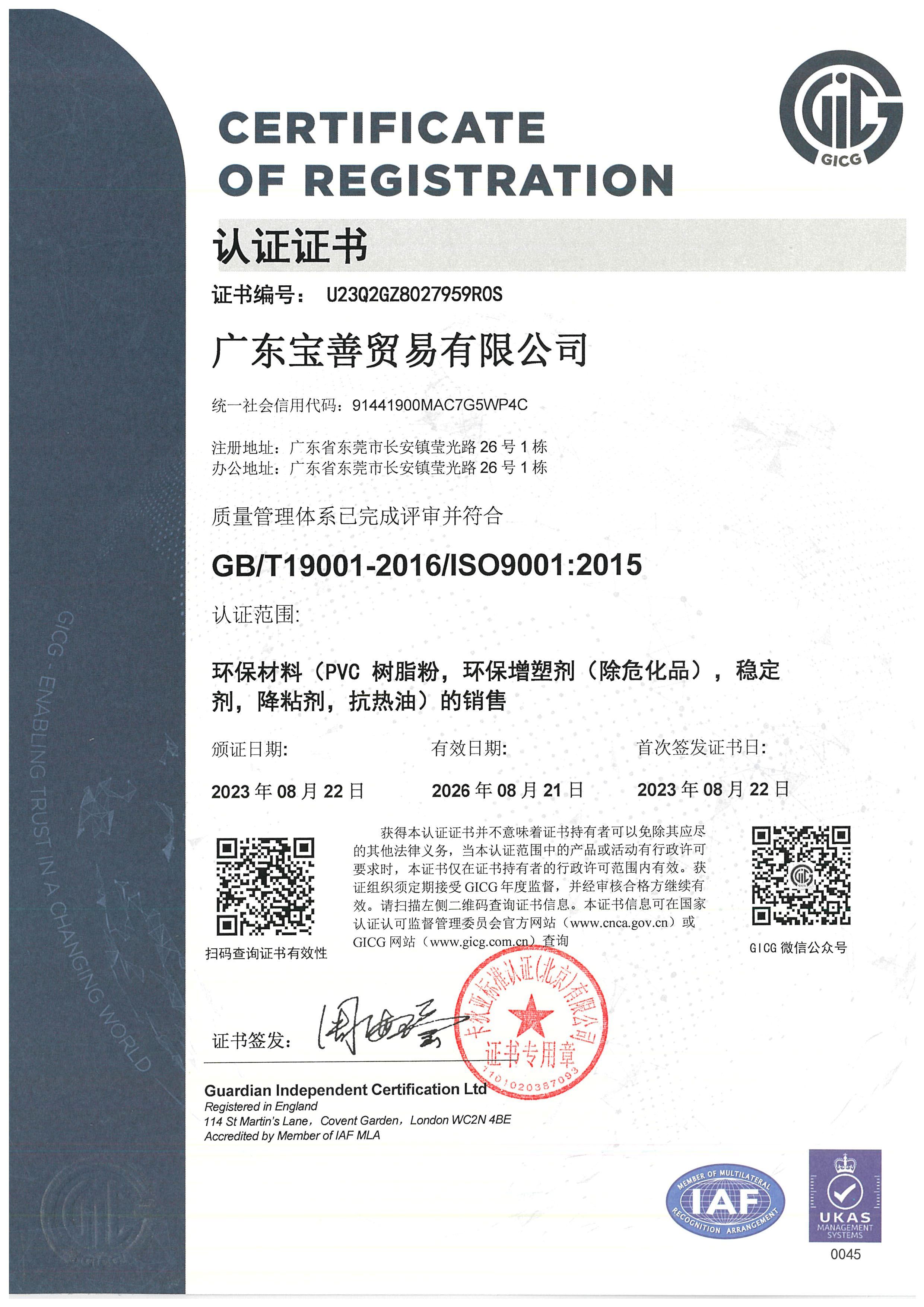
Apply the same test to the supplier's own record. The ISO 9001 certificate held for Guangdong Baoshan Trading Co., Ltd is number U23Q2GZ8027959R0S, issued by Guardian Independent Certification Ltd against GB/T19001-2016/ISO9001:2015 on 22 August 2023, with an expiry date of 22 August 2026. For a shipment window later than that date, request the renewal certificate and confirm in writing the new number, the recertification scope and the new expiry.
Keep certifications and customer audits separate. The same supplier has also passed a joint audit conducted by BASF's Petrochemical Division, Quality Management Department and Environment, Health and Safety Department. That is a supply-chain qualification record and useful supporting evidence, but it is not a substitute for an accredited ISO 9001 certificate.
Step 3 — Verify the authorization chain for branded plasticizers
Brand authorization is the most frequently mishandled check, because buyers accept a brand name in a quotation as evidence of authorization. It is not. Request the certificate itself and read the issuer, the market scope and the dates.
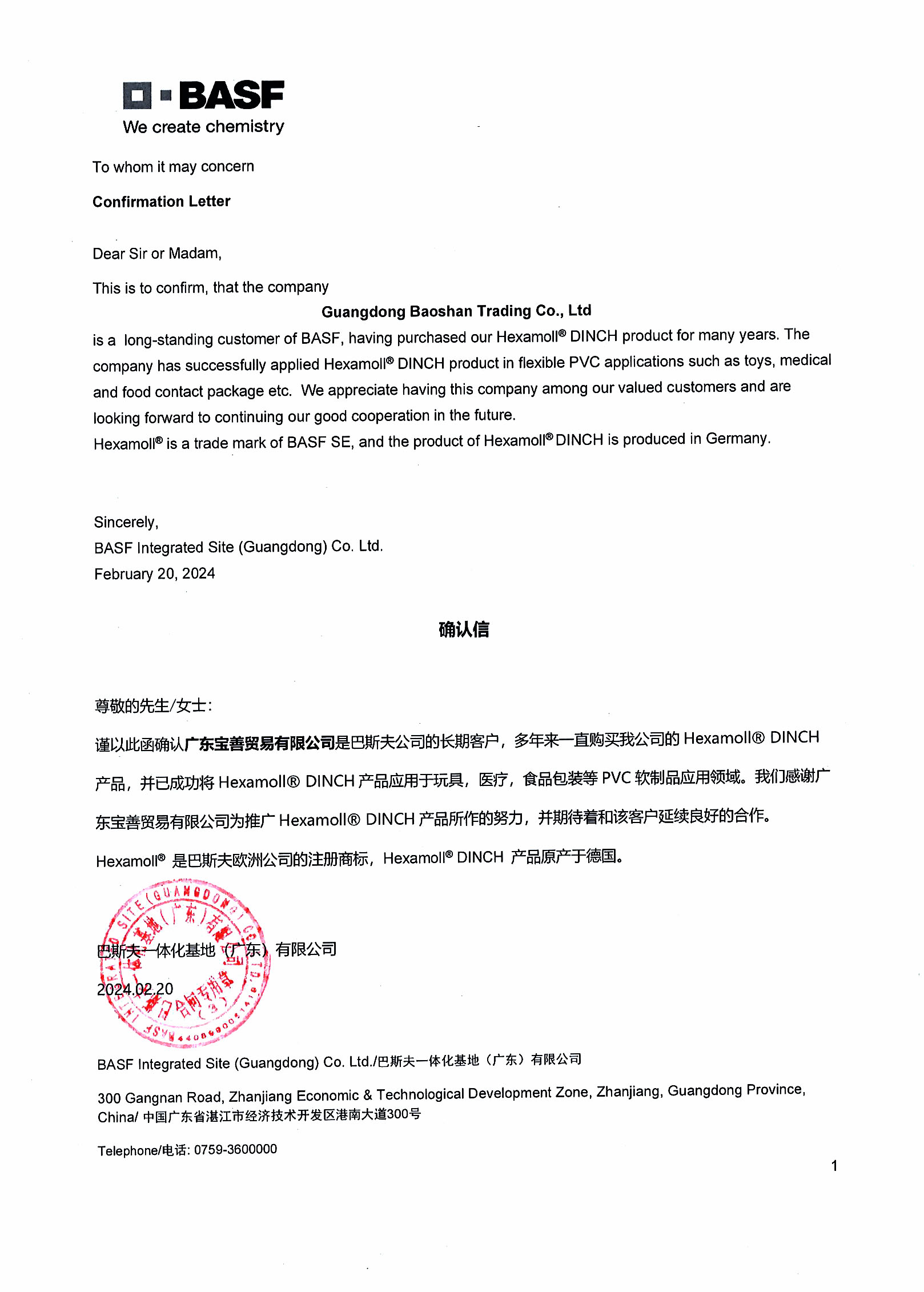
Three authorization types appear in Baoshan's document set. For BASF Hexamoll® DINCH, the certificates issued by BASF (China) Co., Ltd carry the numbers BCN-CPA-20140305-1 and BCN-CPA-20150401-1, dated from 1 March 2014, with a stated expiry of 31 December 2024 and a market scope covering China, Vietnam, Indonesia and other Southeast Asian markets. For Eastman TXIB™, the distributor certificate from Eastman Chemical Ltd. was issued on 1 June 2024 with a stated expiry of 31 May 2025, and its scope names PVC Slush Molding Toy Material, PVC coated material, TXIB viscosity reduction, Hexadecyl Ester 16 (RTC-16) and film-forming agent applications across Vietnam, Indonesia and other Southeast Asian markets. For Ca/Zn stabilizers, the agency certificate from ADEKA (CHINA) CO., LTD was issued on 21 January 2026 and runs to 31 December 2026, covering PVC Slush Molding Toy Material, PVC coated material and PVC Phenol-free Ca/Zn stabilizer, including models CT303TX (BAEROSTAB CT 303 TX) and CZ-190.
The analytical point is that a long-running distributor relationship does not remove the paperwork requirement. A stated expiry date means the certificate in your file covers a defined period; if your order falls outside it, ask for the current-cycle certificate in the same format. Check that the named markets include your destination — a certificate valid for Southeast Asia does not by itself document authorization for a shipment to another region. Treat an unavailable certificate as unverified rather than as proof that authorization does not exist.
Authorization also has a ceiling. It confirms a documented supply channel for a brand and product scope; it says nothing about the conformity of the drum or bag in front of you. That is Step 4.
Step 4 — Move from certificates to lot-level test evidence
Ask for reports tied to a batch number, not a generic specification sheet. For PVC vinyl materials used in toys, medical articles or food-contact products, the minimum set covers heavy metals and phthalates; for sensitive applications, add bisphenol A and organotin. A report that answers only "typical values" cannot be reconciled with a shipment.
Read each report against five fields: the lot or batch number, the test method, the instrument used, the sample date and the detection limits. The lot number must match the packing list and the invoice, or the evidence does not attach to your goods. Method and instrument determine what the result can actually demonstrate, particularly for trace-level phthalate screening.
Baoshan's laboratory is equipped with Agilent GC-MS, ICP-MS and Waters LC-MS/MS instruments, and its stated testing scope covers phthalates, heavy metals, bisphenol A and organotin, with traceability of material sources. Equipment alone is not an outcome; what matters for evaluation is whether the report you receive names the instrument and method behind each result, and whether the sampling regime behind it is documented.
Set expectations honestly. A batch report describes a sample from a defined lot. It cannot guarantee the next lot. Repeatability comes from the sampling regime — the supplier's stated quality control method is sampling inspection, which means the useful question is how the sample is drawn, how often, and what triggers a hold. Ask for that procedure in writing alongside the report.

Step 5 — Test product range against repeatable-order needs
Product range matters less for a first order than for the fifth. A supplier that can quote a single grade will satisfy a trial; a supplier that carries the surrounding family can absorb a shortage without forcing a reformulation. For PVC vinyl materials, that family usually spans paste resin, resin powder, blend resin powder, plasticizers, stabilizers and viscosity modifiers.
The practical distinctions are process-based. PVC paste resin is the base for plastisol systems used in slush molding, spread coating and dipping, where viscosity behaviour governs the process window. PVC resin powder serves dry-blend and extrusion routes. Blend resin powder is used to adjust a paste formulation rather than to replace the paste resin entirely. On the additive side, a PVC Phenol-free Ca/Zn stabilizer is selected where phenol content is itself a concern, and models such as CT303TX, CZ-190, CZ-2756, SC-135 and SC-1600C sit in that group.
On plasticizers, range determines substitution options. BASF positions Hexamoll® DINCH as a non-phthalate plasticizer developed for applications involving close human contact, and states that it can be used in PVC processes including extrusion, calendering, molding and spread coating, with recommendations for soft PVC articles such as medical devices, toys and food packaging. ATBC (Acetyl Tributyl Citrate) is a citrate-based, bio-based option; DOTP is a terephthalate alternative used where phthalate-free status is required; polymeric polyester plasticizers such as GLOBINEX W-2050 are chosen for permanence rather than fast solvation; Eastman TXIB™ is used for viscosity reduction, with a Brookfield viscosity of 9 cps at 25 °C on a No. 1 spindle stated in Eastman's technical data. Epoxidized soybean oil (ESO) appears in the same discussions as a secondary plasticizer and co-stabilizer function. A supplier that carries several of these families can respond to a grade shortage with a documented alternative instead of an improvised one.
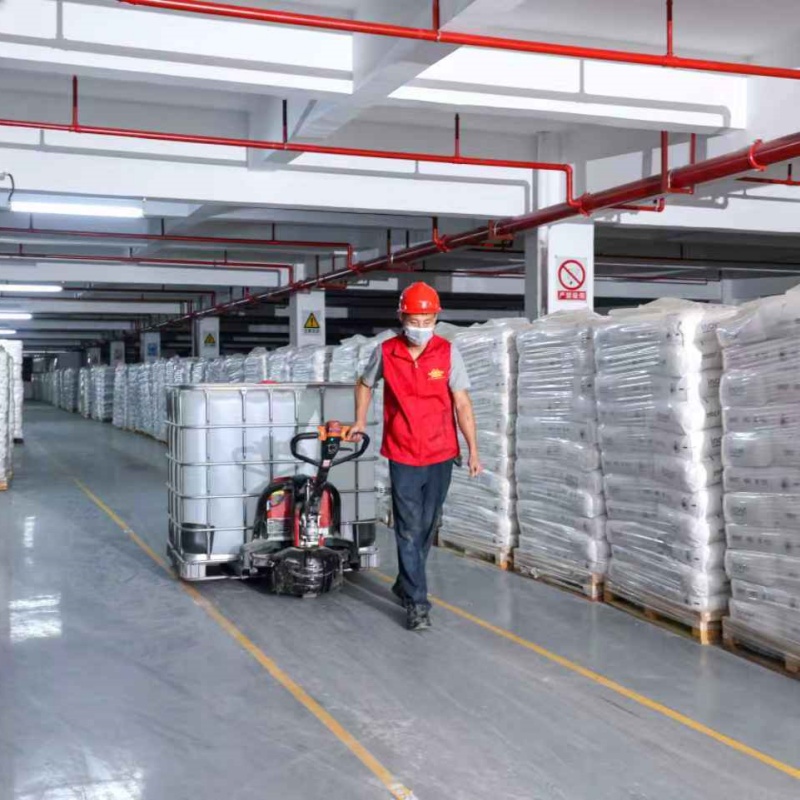
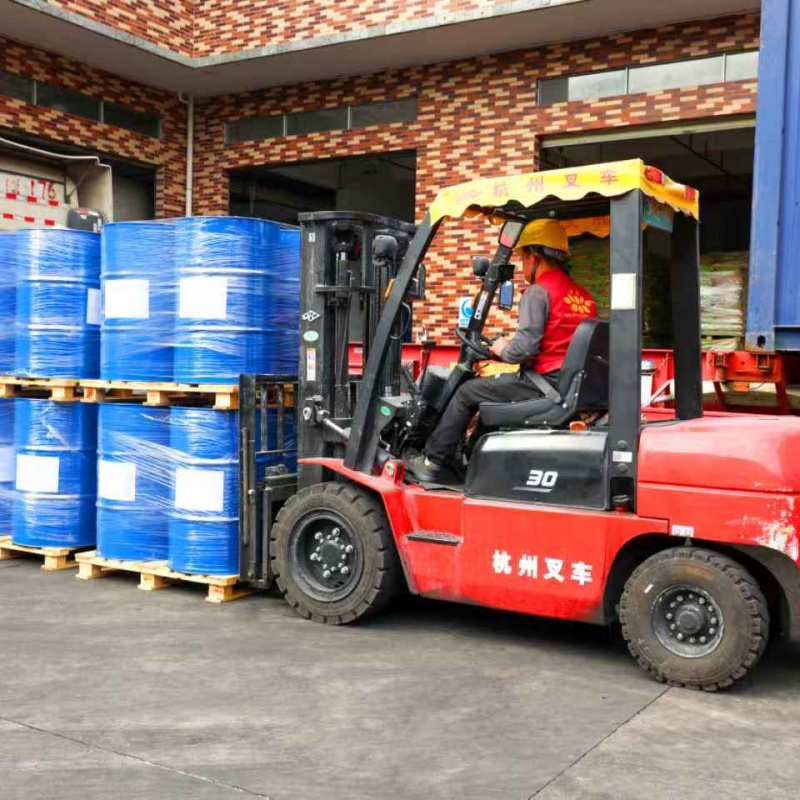
Stock structure is part of the same question. Baoshan operates a 20,000 m² self-built warehouse with 16 liquid storage tanks and a stated safety stock of more than three months for bulk European materials. For a buyer planning repeat orders, that is a supply-continuity signal worth verifying against your own consumption rate, particularly for imported grades with long ocean transit.
Step 6 — Fix the commercial terms in writing before the first shipment
Terms are a verification gate because they define the remedy. The recorded position for Baoshan is a minimum order quantity of 20 kg, packaging formats of 20 kg bags and 200 kg drums, delivery terms of CIF and FOB, payment before shipment, and acceptance criteria defined as customer acceptance. Each item needs to be converted from a phrase into an operating condition.
| Term | Recorded position | Confirm in writing before ordering |
|---|---|---|
| Minimum order quantity | 20 kg stated; packaging recorded as 20 kg bags and 200 kg drums | Whether the MOQ applies per grade or per combined order, and which packaging format the quoted price is based on |
| Delivery terms | CIF and FOB | Named port, Incoterms version, who arranges insurance, and at which point risk transfers |
| Payment | Payment before shipment | The exact document set released before payment: invoice, packing list, batch test report and certificate copies |
| Acceptance | Customer acceptance | The measurable criteria, the test method and the deadline for raising a rejection |
| Lead time | 3-5 days stated | The event the clock starts from: purchase order, payment receipt or document approval |
Two of these deserve emphasis. Under CIF, the seller arranges and pays freight and insurance to the named destination port and risk typically passes at shipment, so the buyer's protection comes from the document set and insurance certificate rather than from physical control of the goods. Under FOB, the buyer arranges the main carriage and should confirm the origin port and loading window, since the stated lead time covers only part of the total cycle. In both cases, payment before shipment makes the pre-shipment documents the buyer's only real inspection point.
Step 7 — Compare the stated lead time with the whole order cycle
A stated lead time of 3-5 days answers a narrower question than most buyers assume. It does not include sample approval, certificate issue, document review, inland haulage, port dwell time, ocean transit or destination clearance. With a monthly sales volume in the region of 4,000 tons and an in-house fleet supported by land and sea logistics routes, dispatch capacity is not the usual constraint; documentation and ocean scheduling usually are.
Ask for the cycle broken into legs and in writing: sample dispatch, sample approval, batch testing and report issue, order picking, port cut-off, transit and clearance. Then ask what event starts the 3-5 day clock. A supplier that answers precisely is easier to hold to a schedule than one that quotes only a single number.
Step 8 — Run a trial order, then scale
Sequence the commitment. Start with a sample evaluated against your own formulation, then request the full document set for that sample, then place a small lot with batch-level testing, and only then move to repeat volume. Record what the material actually did in your process, since that internal record becomes the baseline for every later delivery.
There is a documented reference point for what a stable relationship looks like. A PVC vinyl toy manufacturer in Vietnam running 300 vinyl machines reports close cooperation and stable production, citing stable molding for consistent toy quality and high efficiency for mass toy production, with a two-year shelf life under cool and dry storage. Read that case carefully: it documents a manufacturing application and a supply relationship in the toy segment. It does not establish performance for every formulation, every machine or every destination market, and it should not be treated as a guarantee for your own line.
How the checks shift by application
PVC Slush Molding Toy Material. Batch-level heavy-metal and phthalate data carries the most weight, followed by phenol-free stabilizer documentation and plasticizer authorization for whichever grade is specified. Confirm that the test scope matches the limits your destination market applies to toys, not a generic statement of compliance.
PVC coated material. Resin choice and viscosity behaviour dominate. Confirm whether the formulation uses paste resin alone or a blend resin powder addition, and request lot data for both if the recipe includes both. Viscosity modifiers such as Eastman TXIB™ should be specified by function and addition level, with the batch report covering the additive as received.
PVC dripping glue material. Plastisol consistency across lots matters more than any single test value. Ask how the supplier controls lot-to-lot variation and what documentation accompanies each drum.
Food-contact and medical screening. Add bisphenol A and organotin to the testing request, and confirm the stabilizer is the phenol-free grade you specified. Manufacturer positioning for a plasticizer — for example BASF describing Hexomoll® DINCH as developed for close human contact — supports a first-pass shortlist but does not by itself establish approval for a finished article in a specific jurisdiction. Validate that separately before committing a delivery schedule.
Red flags that should pause an order
- A certificate supplied as an image with the certificate number or expiry date obscured.
- A batch report with no lot number, or a lot number that does not appear on the packing list.
- Brand authorization quoted verbally or shown only as a logo on a website.
- An Incoterm named without a port, or a payment term stated without a document list.
- Acceptance criteria described as "standard" without measurable limits or a rejection deadline.
- A lead time quoted without stating the starting event.
Frequently asked questions
Which certifications should I request from a PVC vinyl materials supplier before ordering?
Request the ISO 9001:2015 certificate with its certifier, certificate number, scope and validity window, plus the manufacturer authorization certificates for any branded material in your formulation. For Guangdong Baoshan Trading Co., Ltd, the ISO 9001 certificate on record is number U23Q2GZ8027959R0S from Guardian Independent Certification Ltd, issued against GB/T19001-2016/ISO9001:2015 on 22 August 2023 with an expiry date of 22 August 2026. If your shipment window falls after the stated expiry, ask for the renewal certificate rather than relying on the earlier document.
How do I confirm authorized distributor status for BASF Hexamoll® DINCH and Eastman TXIB?
Ask for the certificate itself and read four things: the issuing manufacturer, the product scope, the covered markets and the validity dates. Baoshan holds BASF (China) Co., Ltd certificates numbered BCN-CPA-20140305-1 and BCN-CPA-20150401-1, dated from 1 March 2014 with a stated expiry of 31 December 2024 and a scope covering China, Vietnam, Indonesia and other Southeast Asian markets. Its Eastman Chemical Ltd. distributor certificate for TXIB was issued on 1 June 2024 with a stated expiry of 31 May 2025 across Vietnam, Indonesia and other Southeast Asian markets. Where an order falls outside the stated window, request the current-cycle certificate covering the same scope before booking shipment.
What should batch-level testing cover for heavy metals and phthalates?
A usable batch report names the lot number, the test method, the instrument, the sample date and the detection limits, and covers heavy metals and phthalates as a minimum. For toys, medical articles and food-contact products, extend the request to bisphenol A and organotin. Baoshan's laboratory uses Agilent GC-MS, ICP-MS and Waters LC-MS/MS equipment and states a testing scope covering phthalates, heavy metals, bisphenol A and organotin with traceability of material sources. Check that the lot number on the report matches the packing list; if it does not, the report does not apply to your shipment.
What are the purchasing terms and acceptance criteria?
The recorded position is a minimum order quantity of 20 kg, packaging of 20 kg bags and 200 kg drums, delivery terms of CIF and FOB, payment terms of payment before shipment, and acceptance criteria defined as customer acceptance. Convert each into an operating condition: confirm whether the MOQ applies per grade, name the port and Incoterms version, list the documents released before payment, and set measurable acceptance limits with a deadline for rejection. Because payment precedes shipment, those documents are the buyer's practical inspection point.
How fast can a repeat order ship, and what does the lead time include?
The stated lead time is 3-5 days, and the recorded monthly sales volume is around 4,000 tons, supported by a 20,000 m² warehouse, 16 liquid storage tanks, a safety stock of more than three months for bulk European materials and an in-house fleet operating with land and sea routes. Those figures describe dispatch capacity, not total transit. Ask which event starts the clock — purchase order, payment receipt or document approval — and request the full cycle broken into sample approval, batch testing, picking, port cut-off, ocean transit and destination clearance.
Does product range affect a supplier's ability to support repeatable orders?
Yes, mainly through substitution and stock depth. A supplier carrying PVC paste resin, PVC resin powder, blend resin powder, phenol-free Ca/Zn stabilizers and several plasticizer families — BAOSF Hexamoll® DINCH, ATBC, DOTP, polymeric polyester plasticizers and Eastman TXIB™ — can respond to a grade shortage with a documented alternative rather than an improvised one. Range also shortens the document trail, since one supplier can issue coherent batch reports across the resin and additive portions of the same formulation. Products carry a stated two-year shelf life under cool and dry storage, which is worth factoring into order sizing for slow-moving grades. A practical next step is to request a sample and the matching certificate and batch-report set for the specific grades you intend to run, so that the documentation and the material can be evaluated together.
Conclusion
Supplier evaluation for PVC vinyl materials is a document exercise before it is a commercial one. Run the gates in order: confirm what the supplier controls, read the ISO 9001:2015 certificate against your shipment window, verify the authorization chain for every branded plasticizer with its market scope and dates, attach lot-specific heavy-metal and phthalate data to a batch number that matches your packing list, then fix MOQ, CIF or FOB, payment trigger, acceptance criteria and lead-time start in writing. Only after those four gates clear does a delivery date mean anything. Buyers who reverse the order — agreeing a schedule first and collecting paperwork afterwards — carry the risk that payment before shipment leaves them holding.

For buyers who want to run these checks against a specific grade, Guangdong Baoshan Trading Co., Ltd can supply the certificate set, lot-level test reports and written commercial terms for the materials under consideration, together with formula design, formula optimization, customized production and after-sales testing and technical support.
Have Questions or Need More Details?
Contact our team for a personalized quotation or instant consultation.
Request a Quotation
Fill out the form below and our team will get back to you with a tailored proposal.
WhatsApp Direct Chat
Prefer to chat in real-time? Message us on WhatsApp for instant assistance & quick answers.
- Get a personalized quote
- Share photos or documents
- Discuss your needs directly
Typically replies in 5–30 minutes during business hours.