
Plastisol Viscosity Drift: A PVC Vinyl Materials Problem-Solution Guide
Formulation troubleshooting · Coating, slush molding and foam lines
A coating line mixes a PVC plastisol that measures clean on the first morning and then thickens overnight in the storage tank. By the second shift the paste is heavier at the coating head, the coat weight has drifted, foam cells collapse in the oven, and the reject tray fills with imperfect shells. Nothing in the raw-material paperwork looks wrong.
That pattern — viscosity rising during storage rather than at mixing — is the most common formulation-side complaint in paste PVC processing. It is rarely one bad ingredient. It is a balance problem between the resin's particle structure, the plasticizer's solvation behaviour, filler loading, stabilizer chemistry and storage temperature. This guide works through it in the order a converter meets it: symptoms, root causes, a specification-based diagnosis, the correcting materials, and the sourcing checks that keep the fix inside a regulated envelope.
Short answer. Plastisol viscosity drift is corrected at four points: (1) a medium blend resin powder that lowers paste viscosity at the same solids level, (2) a low-viscosity formulation additive such as Eastman TXIB, (3) a plasticizer that solvates slowly and holds viscosity in storage — BASF Hexamoll® DINCH or ATBC — and (4) a phenol-free Ca/Zn stabilizer sized to the actual oven window, such as CZ-2756. Confirm each change with a lab ladder and batch-level testing before it reaches production.
Problem Definition: What Viscosity Drift Actually Looks Like
Viscosity drift is a change in paste rheology over time, not a change in the recipe. A plastisol that leaves the mixer inside its working window and is three days old at the coating head behaves like a different material: it pumps slower, deairs poorly and lays down differently.
On the line, the symptoms usually cluster:
- Coating weight creep. The same pump setting delivers a heavier wet film as the paste thickens, so dry coat weight drifts upward and caliper changes.
- Wave marks and flow lines at the coating head under high shear, because flow characteristics degrade as the paste stiffens.
- Foam collapse or coarse, uneven cells in foamed layers, where the blowing window no longer matches the paste rheology.
- Bubbles and pinholes because air entrained during mixing is not released before gelation.
- Incomplete fill in slush molds — corners and thin sections starve, while heavy build-up appears at gates.
- Batch-to-batch inconsistency that tracks with storage age rather than with supplier lot.
The instinctive response — thin the paste with more plasticizer — reduces viscosity but also changes modulus, hardness and tensile behaviour, and it moves the formulation away from the property set that was actually tested for compliance. Drift is better treated as a materials-balance question than as a dilution problem.
Industry Background: Why Drift Is Showing Up More Often
Paste PVC demand keeps expanding, and so does the range of plasticizers used in it. Market Research Future estimated the global PVC paste resin market at USD 2.67 billion in 2024, with a projected USD 4.473 billion by 2035. The same source places Asia-Pacific above 60% of global paste-grade resin volume, with China alone accounting for more than 45% of consumption.
The plasticizer side has shifted too. MarketsandMarkets valued the global eco-friendly plasticizers market at USD 5.03 billion in 2024, projecting USD 7.55 billion by 2030 at a 7.0% CAGR. Regulation is one driver: EU REACH restricts DEHP, DBP and BBP to concentrations below 0.1% in toys and childcare articles.
Each substitution changes how a paste solvates and how it holds viscosity in storage. A formulation tuned around one plasticizer's solvation rate can drift when that plasticizer is replaced by a slower-solvating alternative — even when every individual certificate is in order. That is why drift now surfaces as a formulation-engineering task rather than a purchasing complaint.
Detailed Solution: Correcting Drift With the Right PVC Vinyl Materials
The fix has three layers: modify the resin blend, modify the additive package, and re-qualify the compliant plasticizer and stabilizer set. Doing only one of the three usually trades one defect for another.
1. Resin side — blend resin powder BJ-65
Blend resin powder BJ-65 is a medium-particle polyvinyl chloride powder (CAS 9002-86-2) used together with paste resin to bring paste viscosity down without diluting solids. Its published specification is unusually specific for a rheology tool, which makes it diagnostic-friendly:
| BJ-65 parameter | Published value | Why it matters for drift |
|---|---|---|
| K value | 65 (grade) | Mid-range molecular weight; predictable gelation behaviour alongside paste resin grades |
| Average particle diameter | 20–40 µm (medium powder) | Particle size drives plasticizer uptake rate and therefore viscosity over time |
| Apparent density | 0.45–0.52 g/cm³ | Bulk handling and dispersion behaviour in the mixer |
| Volatile matter | ≤0.4% | Volatiles contribute to paste instability and bubble entrainment |
| Residual VCM | ≤5 ppm | Keeps the resin usable in toy and food-contact discussions |
| Polymerization degree | ~1000 | Consistency with medium-grade processing windows |
Blended with paste resin (P-PVC), BJ-65 noticeably lowers PVC paste viscosity and improves processing flowability; supplier data states it reduces plasticizer consumption by 10–20%. It also delivers a smooth matte finish, and it is described as mixing with paste resins, plasticizers and stabilizers without impairing the physical and mechanical properties of the finished product. Application coverage spans slush-molded toys, soft toys, artificial leather, vinyl flooring, wallpaper, decorative films, automotive underbody and interior trim coatings, canvas coating, conveyor belts, bottle cap gaskets and sealing materials.
2. Additive side — Eastman TXIB viscosity reduce
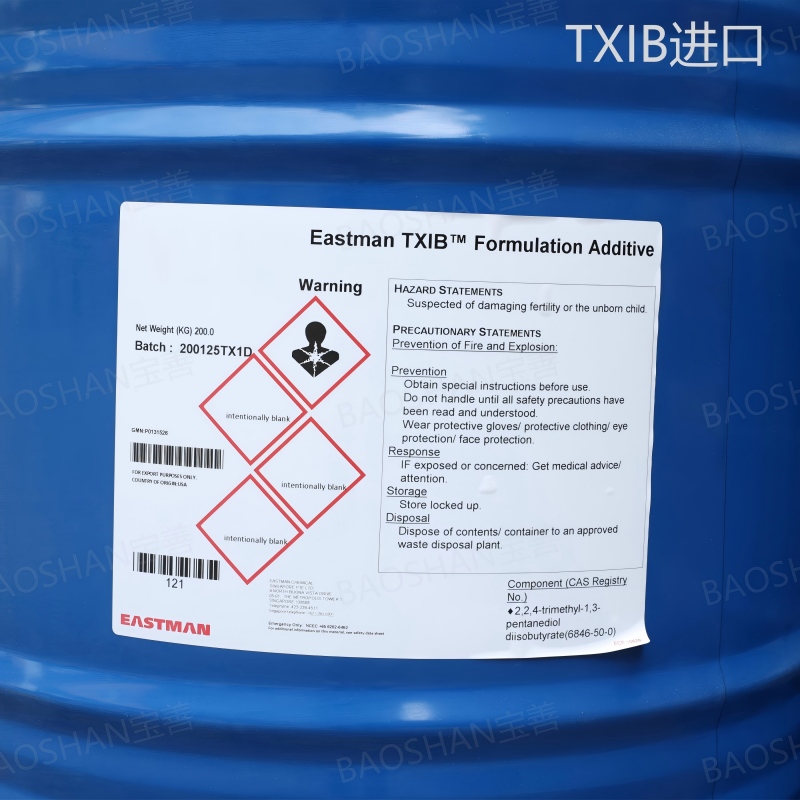
Eastman TXIB (2,2,4-trimethyl-1,3-pentanediol diisobutyrate, CAS 6846-50-0) is the second lever. It works as a dual-function additive: it plasticizes and it reduces viscosity, which means it restores flow without the mechanical penalty of straight dilution.
Its physical profile explains the behaviour. Brookfield viscosity is 9 cP at 25 °C, specific gravity 0.942–0.948 at 20 °C, freezing point −70 °C, flash point 143 °C (Cleveland open cup) and assay ≥98.6 wt%. Hydrolysis after 96 hours at 98–99 °C is 0.003%, which is why it holds up in humid process environments and in aqueous systems. It is a non-VOC substance, free of phthalates and benzene rings, and compliant with EU REACH and RoHS.
In plastisol terms, TXIB reduces initial viscosity and maintains viscosity stability, improves coating processing and flow characteristics, reduces wave marks caused by high-shear coating, allows higher filler loading to reduce cost, and removes bubbles from the sol more quickly. It is compatible with general-purpose plasticizers including DINCH, DOTP and ATBC, and shows good synergy with calcium-zinc stabilizers.
3. Compliance side — plasticizer and stabilizer pairing
Once the rheology is corrected, the formulation still has to clear its regulatory route. Three materials cover most of the ground:
- BASF Hexamoll® DINCH — a non-phthalate plasticizer with phthalate content ≤0.01%, ester content ≥99.5% and water content ≤0.1%. It has passed EU REACH, RoHS and PAHS, holds food-contact permits from Germany's BFR and Japan's Hygienic PVC Association, and can be used in toys for children under three. In PVC paste resins such as Kaneka EH251 and Shenyang PSH-10 it has been shown to reduce initial viscosity by 10–20%, improve viscosity stability and extend storage period by 20–30%.
- ATBC (Acetyl Tributyl Citrate, CAS 77-90-7) — a bio-based plasticizer with purity ≥99.0%, freezing point ≤−80 °C and heavy metal content (as Pb) ≤10 mg/kg. It is compliant with REACH, RoHS, FDA and GB 4806, and is used in toys meeting EN71-3, in food-contact film and in medical-grade PVC.
- Phenol-free Ca/Zn stabilizer CZ-2756 — density 1.02–1.08 g/cm³ at 25 °C, viscosity 200–250 mPa·s at 30 °C, thermal stability ≥30 minutes at 180 °C (Congo red), VOC ≤0.5%, with phenolic substances not detected. It is free of phenols, lead, cadmium and heavy metals, passes REACH, RoHS, PAHS and EN71-3, and is recommended for processing at 160–185 °C.
The stabilizer choice is not cosmetic in a drift investigation. A paste that sits in a warm tank loses heat stability before it ever reaches the oven, and a stabilizer with weak initial colour or short long-term heat resistance will show yellowing exactly when the operator is already chasing a viscosity problem.
Where the fix has limits
No additive rescues a paste stored outside its design conditions. Storage temperature, tank agitation and headspace all act on viscosity independently of formulation, and a converter should record them alongside viscosity readings. Equally, a viscosity reducer changes flow behaviour, not the compliance status of the plasticizer: if the plasticizer system is not on the approved list for the end market, correcting rheology does not make the product compliant.
Step-by-Step Breakdown: Diagnosing and Correcting Drift on the Line
The sequence below keeps the investigation in the plant rather than in a supplier's inbox, and each step produces a record that supports the next.
- Baseline the paste properly. Record viscosity at 25 °C immediately after mixing, then at 24 hours, 72 hours and 7 days, always at the same temperature and shear condition. Drift is defined by the slope of that curve, not by a single reading.
- Audit the storage variables. Log tank temperature, agitation state and time since mixing for each batch that failed. A drift that tracks storage age but not supplier lot points at the paste system, not at incoming quality.
- Check the resin against its published window. Compare the certificate of analysis with the BJ-65 window above — K value 65, 20–40 µm particle size, 0.45–0.52 g/cm³ apparent density, ≤0.4% volatiles. A resin outside its volatile or particle-size window will show up as an unstable paste before it shows up as a failed part.
- Run a viscosity-reducer ladder. Evaluate Eastman TXIB at several addition levels against the current paste, measuring both initial viscosity and 7-day viscosity. The objective is the lowest addition that holds the paste inside the coating window, not the lowest viscosity achievable.
- Rebalance the plasticizer, do not just top it up. Test a partial substitution toward DINCH or ATBC and re-measure viscosity, hardness and tensile behaviour. The published DINCH data — 10–20% lower initial viscosity and 20–30% longer storage period in specified paste resins — is a starting hypothesis to confirm on your own equipment.
- Lock the heat-stability window. Set the CZ-2756 level against the real oven profile within its 160–185 °C recommendation, and confirm with a static heat-stability test at 180 °C against the ≥30 minute benchmark.
- Validate compliance at batch level. Request heavy-metal and phthalate testing on the specific batches you will run, not on a generic product certificate. A supplier with in-house GC-MS, ICP-MS and LC-MS/MS capability can return that data with the shipment.
- Qualify the supplier, then the terms. Verify the quality system against GB/T19001-2016/ISO9001:2015, then confirm MOQ, packaging, delivery terms and acceptance criteria in writing before the first production order.

Use Cases: Where Viscosity Drift Bites Hardest
Slush-molded vinyl toys
Slush molding is unforgiving of rheology change: a paste that thickens in the tank will not drain cleanly from the mold and leaves heavy walls and incomplete detail. A PVC vinyl toy manufacturer in Vietnam, working across 300 vinyl machines, used this material set — paste resin with blend resin and plasticizer — and reported stable molding for consistent toy quality and high efficiency for mass toy production, with product shelf life stated at two years under cool, dry storage. The storage caveat matters: the two-year figure assumes those conditions, not a warm plant floor.
Coated fabrics and artificial leather
Coating weight is the quality variable, and drift shows up as caliper variation and wave marks at the head. High-shear coating is exactly the case where TXIB's effect on wave marks and flow characteristics is most visible, and where BJ-65's matte finish removes a separate matting step.
Foamed layers — wallpaper, flooring, cushioning
Foam collapse is the classic late-stage symptom of a paste that has drifted: the blowing window was set for the viscosity the paste had on day one. Restoring the original rheology, rather than increasing blowing agent, keeps the cell structure inside its designed range.
Drip-molded labels and PVC dripping glue material
Drip molding depends on controlled flow into a defined shape. BJ-65's application list explicitly covers plastic coatings and sealing materials, and pairing it with a phenol-free stabilizer keeps the parts inside toy and food-contact discussions.
Regulated lines — toys, food contact and medical
Where DINCH, ATBC and CZ-2756 are already the approved set, drift correction has to happen without disturbing the compliance story. That is the argument for solving rheology with a resin blend and a low-viscosity additive rather than with an unapproved plasticizer.
Comparison Table: The Four Correction Levers Side by Side
| Material | Role in the fix | Verified parameter | Compliance anchor | Practical note |
|---|---|---|---|---|
| Blend resin powder BJ-65 | Lowers paste viscosity at equal solids; adds matte finish | K value 65; 20–40 µm; 0.45–0.52 g/cm³; volatiles ≤0.4%; VCM ≤5 ppm | Low residual VCM; used in toy and coating applications | Supplier data cites 10–20% lower plasticizer consumption; confirm on your own paste |
| Eastman TXIB | Viscosity reduction plus plasticization; faster deairing | 9 cP at 25 °C; SG 0.942–0.948; freezing point −70 °C; assay ≥98.6% | Non-VOC; REACH and RoHS compliant; phthalate- and benzene-ring-free | Reduces wave marks under high shear; compatible with DINCH, DOTP and ATBC |
| BASF Hexamoll® DINCH | Primary plasticizer with slow solvation and stable paste viscosity | Phthalate content ≤0.01%; ester content ≥99.5%; pour point −54 °C | REACH, RoHS, PAHS; BFR and Japan Hygienic PVC Association food contact; suitable for toys under 3 years | 10–20% lower initial viscosity and 20–30% longer storage period measured in specified paste resins |
| ATBC | Bio-based primary plasticizer for regulated applications | Purity ≥99.0%; freezing point ≤−80 °C; heavy metal as Pb ≤10 mg/kg | REACH, RoHS, FDA, GB 4806; used in EN71-3 toy applications | Low-temperature flexibility; used in food-contact and medical PVC |
| Phenol-free Ca/Zn stabilizer CZ-2756 | Heat stability during processing and storage | Thermal stability ≥30 min at 180 °C; VOC ≤0.5%; viscosity 200–250 mPa·s at 30 °C | Phenol-free; no lead, cadmium or heavy metals; REACH, RoHS, PAHS, EN71-3 | Recommended processing window 160–185 °C; phenolic substances not detected |

Sourcing the Correction: Testing, Quality System and Terms
Guangdong Baoshan Trading Co., Ltd. is a Dongguan-based supplier of PVC vinyl materials, founded in 1994, serving China and Southeast Asian markets including Vietnam and Indonesia, and acting as a distributor of BASF Hexamoll® DINCH and Eastman TXIB in China. Its service scope includes formula design, formula optimization and customized production, plus after-sales testing services and technical support.
For drift investigations, three supplier capabilities shorten the loop between complaint and correction:
- Batch-level testing. An in-house laboratory equipped with Agilent GC-MS, ICP-MS and Waters LC-MS/MS supports testing for phthalates, heavy metals, bisphenol A and organotin, with traceability back to material source.
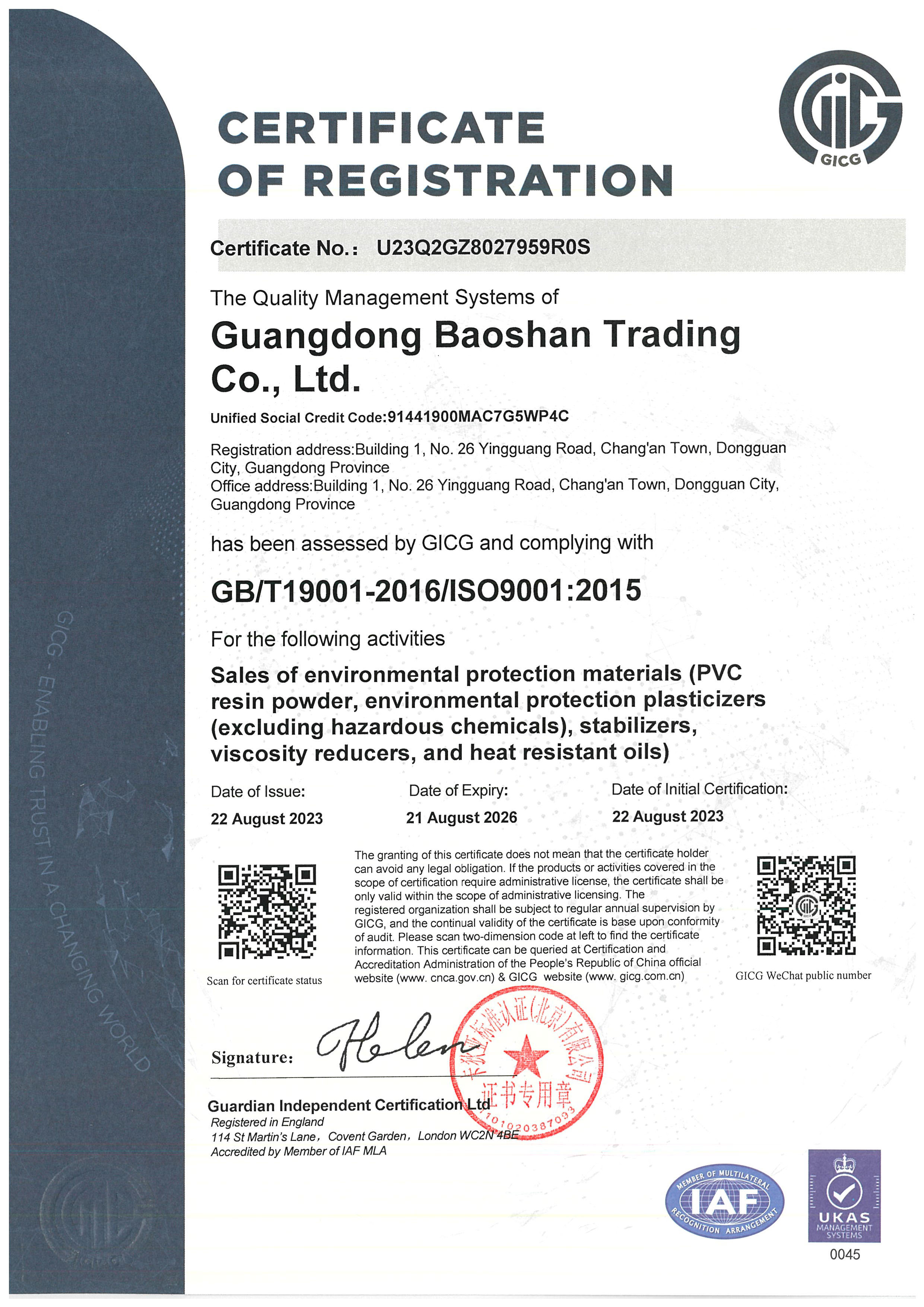
- A verifiable quality system. The company's quality management system is certified to GB/T19001-2016/ISO9001:2015 under certificate U23Q2GZ8027959R0S issued by Guardian Independent Certification Ltd.
- Supply continuity. A 20,000 m² warehouse with 16 liquid storage tanks and safety stock covering more than three months of bulk European material supports repeatable batches rather than spot lots.
Frequently Asked Questions
Which plasticizers and stabilizers keep a viscosity-corrected plastisol inside REACH, RoHS, FDA, GB 4806 and EN71-3?
Three materials cover most regulated routes. BASF Hexamoll® DINCH has phthalate content ≤0.01% and has passed EU REACH, RoHS and PAHS; it holds food-contact permits from Germany's BFR and Japan's Hygienic PVC Association and is suitable for toys for children under three. ATBC is compliant with REACH, RoHS, FDA and GB 4806, carries heavy metal content (as Pb) ≤10 mg/kg, and is used in toys that meet EN71-3. Phenol-free Ca/Zn stabilizer CZ-2756 contains no phenols, lead, cadmium or heavy metals, reports phenolic substances as not detected, and passes REACH, RoHS, PAHS and EN71-3. EU REACH restricts DEHP, DBP and BBP to below 0.1% in toys and childcare articles, so any plasticizer change should be checked against that limit before production.
Can a blend resin powder replace part of the paste resin without hurting physical properties?
BJ-65 is a medium blend resin powder with a K value of 65, an average particle size of 20–40 µm, an apparent density of 0.45–0.52 g/cm³ and volatiles ≤0.4%. Blended with paste resin, supplier data states that it lowers PVC paste viscosity, improves processing flowability and reduces plasticizer consumption by 10–20%, while mixing with paste resins, plasticizers and stabilizers without impairing the physical and mechanical properties of the finished product. It also provides a matte surface finish. Because the effect depends on the paste resin grade and plasticizer system in use, the substitution ratio should be confirmed with a lab ladder before production scheduling.
Where does the cost of the correction actually change?
Two levers move cost in opposite directions. BJ-65 is specified to reduce plasticizer consumption by 10–20% when blended with paste resin, which offsets part of the material cost. Eastman TXIB allows higher filler loading in the formulation, which reduces compound cost, and its viscosity of 9 cP at 25 °C means it works at modest addition levels. Against those savings sit the qualification costs: viscosity curves, heat-stability testing and batch-level heavy-metal and phthalate testing. Treat the correction as a formulation project with a test budget rather than as a straight material swap.
Can we test the corrected formulation before committing to drums?
Yes. The minimum order quantity is 20 kg, with standard packaging at 200 kg per drum and 20 kg per bag, which allows a genuine trial rather than a desk evaluation. Customization support covers formula design, formula optimization and customized production, and after-sales support includes testing services and technical support, so a converter can run the viscosity ladder, the heat-stability check and compliance testing on the same material set that will go into production. To arrange a sample set or request a quotation, contact Guangdong Baoshan Trading Co., Ltd. at misscheng1984@163.com or +86 13580992838; the company and product reference is published at www.baoshancl.cn.
What are the lead time and trade terms for a repeat order?
Lead time is 3–5 days. Delivery terms are CIF and FOB. Acceptance criteria are customer acceptance, and payment terms are payment before shipment. Monthly sales volume is 4,000 tons, and safety stock of more than three months on bulk European material supports repeat ordering without long gaps between batches.
Turn the drift into a documented formulation change
Send your current paste system, target viscosity window and end-market compliance route. Baoshan can return a formulation recommendation, a sample set from 20 kg, and batch-level test data for heavy metals and phthalates.
Email: misscheng1984@163.com · Tel: +86 13580992838 · WhatsApp: +84 865388399
Conclusion
Plastisol viscosity drift is diagnosed by its slope, not its value: measure the paste at 24 hours, 72 hours and 7 days, log the storage conditions, and compare the resin against its published window. Once the drift is confirmed, correct it on three fronts at once — a blend resin powder such as BJ-65 to lower paste viscosity at equal solids, a low-viscosity formulation additive such as Eastman TXIB to restore processing latitude, and a plasticizer and stabilizer pair such as BASF Hexamoll® DINCH or ATBC with phenol-free CZ-2756 to keep the formulation inside its regulatory route.
The last step is the one most often skipped: validate the corrected system at batch level for heavy metals and phthalates, confirm the supplier's quality system against GB/T19001-2016/ISO9001:2015, and settle MOQ, packaging, delivery terms and acceptance criteria in writing. A drift fix that is not documented is only a temporary reprieve.
Specifications quoted in this article are the published values held in the material data sheets for these grades. Confirm them against the certificate of analysis for the specific batch before releasing a production formulation.
Have Questions or Need More Details?
Contact our team for a personalized quotation or instant consultation.
Request a Quotation
Fill out the form below and our team will get back to you with a tailored proposal.
WhatsApp Direct Chat
Prefer to chat in real-time? Message us on WhatsApp for instant assistance & quick answers.
- Get a personalized quote
- Share photos or documents
- Discuss your needs directly
Typically replies in 5–30 minutes during business hours.