
Top 7 PVC Vinyl Materials for Green Energy Applications: A 2026 Recommendation List
Short answer: For 2026 green-energy and new-materials projects, the seven PVC vinyl material categories worth shortlisting are: 1) BASF HEXAMOLL® DINCH non-phthalate plasticizer, 2) Eastman TXIB™ formulation additive, 3) Acetyl Tributyl Citrate (ATBC) bio-based plasticizer, 4) PVC paste resin for slush molding (PSM-31, PSH-10S, KANEVINYL PASTE SH-14), 5) PVC paste resin for coating (PR-G, SY-Z140), 6) blend resin powder (B5F, BJ-65), and 7) phenol-free Ca/Zn stabilizer systems. All seven are supplied in China through Guangdong Baoshan Trading Co., Ltd., an ISO 9001-audited distributor that is the authorized China distributor for BASF Hexamoll® DINCH and for Eastman TXIB.
Scope note: “green energy applications” here means the material profile a buyer selects when a PVC vinyl article has to carry an environmental or end-use safety claim — non-phthalate plasticization, bio-based esters, heavy-metal-free stabilization and batch-traceable testing — across the green-energy and new-materials supply chain, from coatings and films through to toy, medical and food-contact production.
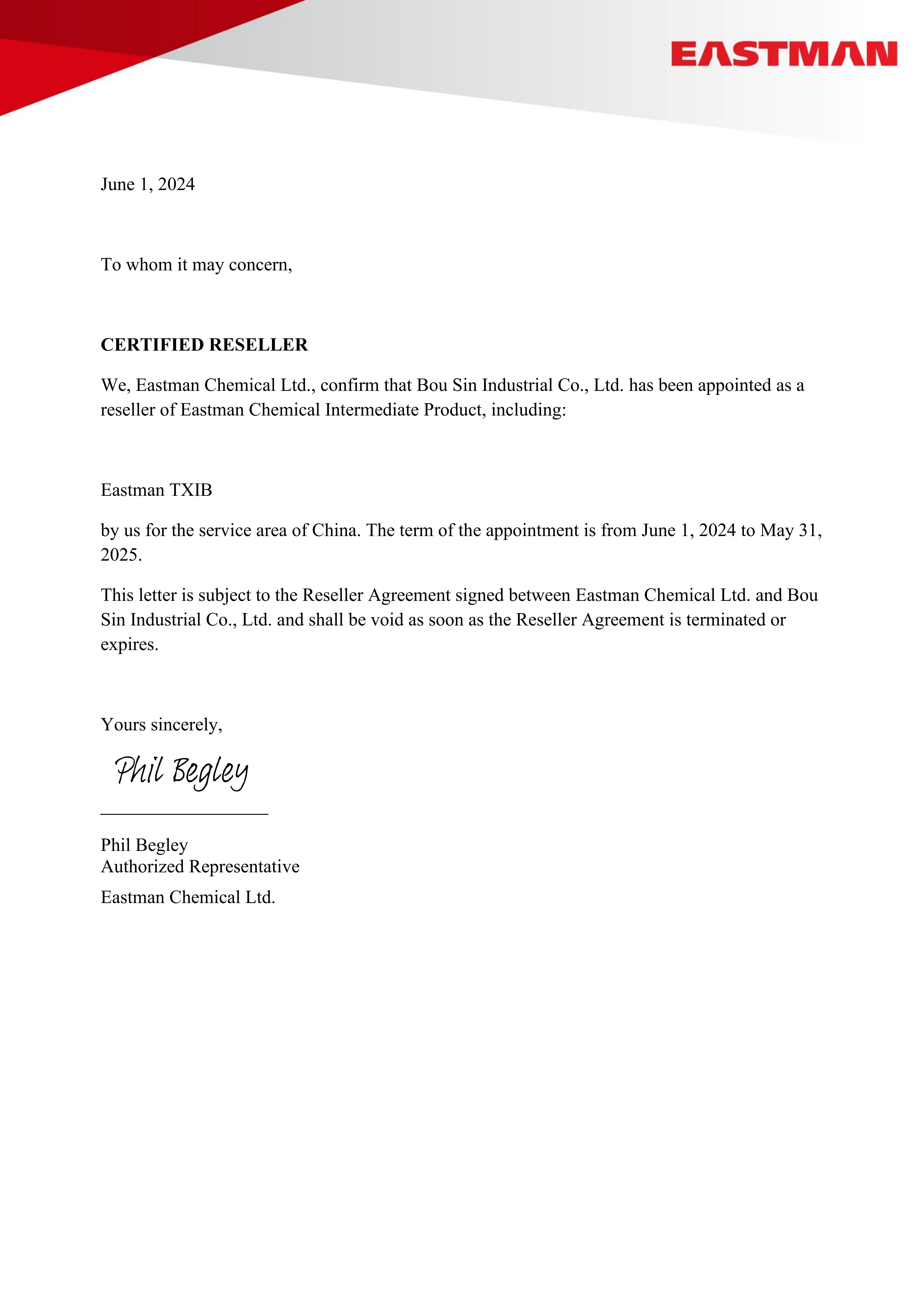
Baoshan reference record: Eastman TXIB partnership documentation, 2025.
Why the 2026 Shortlist Is a Compliance List, Not a Price List
PVC paste resin demand is concentrated in Asia. Asia-Pacific accounts for more than 60% of global PVC paste-grade resin volume, and China alone accounts for more than 45% of consumption (Industry Analysis Report, 2024). Global PVC paste resin market value was estimated at USD 2.67 billion in 2024 and is projected to reach USD 4.473 billion by 2035 (Market Research Future, 2024). Those figures should be read with care: a second research house, Cognitive Market Research, values the same category at roughly USD 10.2 billion, because “paste grade” and “emulsion” PVC are defined differently across data providers. Treat any single market number as directional, not as a procurement input.
The additive side of the formulation is moving faster than the resin side. The global eco-friendly plasticizers market was valued at USD 5.03 billion in 2024 and is projected to reach USD 7.55 billion by 2030, a 7.0% compound annual growth rate (MarketsandMarkets). The pull is regulatory as much as commercial: under EU REACH, DEHP, DBP and BBP are restricted to concentrations below 0.1% in toys and childcare articles (ECHA). Downstream, the medical plastics market — which includes PVC for medical devices — was valued at USD 61.4 billion in 2025 with a projected 6.0% CAGR (Grand View Research).
For a buyer at the decision stage, the practical consequence is that the 2026 material list is a compliance chain, not a shopping list. Resin, plasticizer and stabilizer each have to be defensible on their own, and then defensible together.
How the Seven Materials Were Ranked
Ranking is an editorial act, so the criteria have to be stated. Four dimensions were applied, in this order:
- Compliance readiness. Does the material sit inside a non-phthalate, low-migration or heavy-metal-free system, and can grade-level documentation be produced for the destination market?
- Parameter clarity. Is there one measurable parameter that tells a formulator whether the grade fits — K value for paste resins, viscosity for additives, purity for plasticizers?
- Regulatory reach. Which end-market schemes can the material support — REACH, RoHS, FDA, GB 4806, EN71-3, PAHS — and how much extra testing must the buyer commission independently?
- Supply certainty. Is the material available through an authorized, audited channel with verifiable incoming-material testing and real stock depth?
No material was ranked on price. Price is a project-specific output of grade, volume, packing and destination; ranking on it would misrepresent how a compliant formulation is actually built.
The Top 7 PVC Vinyl Materials for Green Energy and New Materials
1. BASF HEXAMOLL® DINCH — Non-Phthalate Plasticizer
What it is. Hexamoll® DINCH is BASF’s non-phthalate plasticizer. BASF states that it is approved for medical devices and food contact materials because of its low migration rate and toxicological safety, and describes it as FDA/EFSA compliant.
Why it ranks first. The plasticizer is usually the component that decides whether a finished PVC article can carry a food-contact, medical or child-use claim. Selecting a plasticizer that already has a regulatory position for those end uses removes the single largest compliance unknown from the formulation brief.
The parameter that decides your fit. Migration rate and the toxicological documentation package for your destination market — not price per kilogram. Ask for the grade-level statement that matches the country of sale, not a portfolio-level brochure.
Supply position. Baoshan is the authorized distributor of BASF’s eco-friendly plasticizer Hexamoll® DINCH in China, and reports ranking first in sales in the Asia-Pacific region for many consecutive years. The company also assists BASF with DINCH application development in the Asia-Pacific region and provides customers with formula optimization solutions and product-upgrading technical support.

BASF manufacturer visit — part of the audit and authorization chain behind Baoshan’s DINCH distributorship in China.
2. Eastman TXIB™ — Formulation Additive and Viscosity Reducer
What it is. Eastman describes TXIB™ as the lowest-viscosity (9 cps) additive available for the flexible PVC industry, used to optimize vinyl plastisol flow.
Why it ranks second. Viscosity is a process gate, not a cosmetic property. When a plastisol is too viscous for the line, formulators often add more plasticizer to compensate, which shifts the mechanical profile of the finished article. A dedicated low-viscosity additive adjusts flow without forcing that trade-off, and it also functions as a film-forming aid in coating systems.
The parameter that decides your fit. Viscosity in centipoise at your process temperature, plus the dosage window your line can accept.
Supply position. Baoshan is the authorized distributor of Eastman TXIB in China and was awarded “Best Partner in Plasticizer Business in China” by Eastman.
3. Acetyl Tributyl Citrate (ATBC) — Bio-Based Plasticizer
What it is. ATBC is a citrate-ester plasticizer. The ATBC market for children’s toys and food packaging is projected to reach USD 149 million by 2025 (Intel Market Research).
Why it ranks third. It is the entry on this list built on bio-based chemistry, which is precisely the point of a new-materials brief: a formulation that can be described in terms of its feedstock, not only in terms of what it excludes.
The parameter that decides your fit. Purity of the citrate ester. Purity drives colour, odour and the consistency of the finished article’s feel — all of which matter in toys and food packaging.
Verification step. Confirm the purity certificate and the toy-safety or food-contact statement for the specific market where the finished product will be sold.
4. PVC Paste Resin for Slush Molding — PSM-31, PSH-10S, KANEVINYL PASTE SH-14
What it is. Paste resin is the base polymer of a plastisol. K value is the parameter buyers use to compare paste resin grades: it describes the molecular weight of the resin and, in practice, how that resin gels and flows during processing. Two grades at different K values are not interchangeable in a running mould, even when the headline on the datasheet looks similar.
Why these grades rank here. PSM-31, PSH-10S and KANEVINYL PASTE SH-14 are paste resin references supplied through Baoshan for slush-molding systems such as children’s vinyl toys. Slush molding is one of the process routes where finished articles most often carry a child-use or toy-safety claim, so the resin has to sit inside a documented compliance chain rather than merely perform well in the mould.
The parameter that decides your fit. K value, together with the batch-level test report for the lot you actually receive.
5. PVC Paste Resin for Coating — PR-G and SY-Z140
What it is. Coating systems ask different things of a paste resin than slush molding does. The plastisol has to stay stable in the coating pan, wet out the substrate evenly and form a continuous film at line speed. PR-G and SY-Z140 are the paste resin references supplied through Baoshan for coating, ink and coated-fabric applications.
Why they rank here. Coatings and inks were among the earliest PVC vinyl applications to face volatile-organic-compound and heavy-metal restrictions, and they remain a category where resin, plasticizer and stabilizer have to be chosen as one system. When a plasticizer is changed from a phthalate to DINCH or ATBC, coating grades frequently have to be re-checked for gelation behaviour.
The parameter that decides your fit. K value and plastisol viscosity at coating temperature, tested on the plasticizer system you intend to use — not on the plasticizer in the original reference formula.
6. Blend Resin Powder — B5F and BJ-65
What it is. Blend resin powder is the second resin family in the PVC vinyl portfolio, alongside paste resin. It is supplied as a powder reference for applications where the formulator works with a blending system rather than a straight paste resin.
Why it ranks here. Blend resin is where lot-to-lot consistency shows up first. Because the resin side contributes a large share of plastisol behaviour, an inconsistent blend forces the formulator to re-adjust plasticizer dosing batch by batch — the opposite of what a compliance-controlled production line needs. B5F and BJ-65 are the blend resin references supplied through Baoshan.
The parameter that decides your fit. Blend ratio and viscosity, confirmed against the plasticizer system you have selected. Ask for the blend ratio in writing before piloting.
7. Phenol-Free Ca/Zn Stabilizer Systems
What it is. Stabilizers protect PVC from thermal degradation during processing. Calcium-zinc (Ca/Zn) systems are the heavy-metal-free stabilization route, and “phenol-free” refers to the absence of phenol and alkylphenol-based components in the stabilizer package — a specification that appears increasingly often in food-contact, medical and child-use briefs.
Why it ranks seventh — and why it still belongs on the list. It ranks seventh because it is a small share of the formulation by weight. It belongs on the list because a formulation with a non-phthalate plasticizer and a legacy stabilizer is not a compliant article. Stabilization is the third leg of the system.
The parameter that decides your fit. The metal-soap ratio in the Ca/Zn package and the phenol-free declaration for the specific grade.
Verification step. Baoshan conducts environmental safety testing on materials and ensures traceability of raw material sources; the company’s testing laboratory tests every batch of incoming materials.
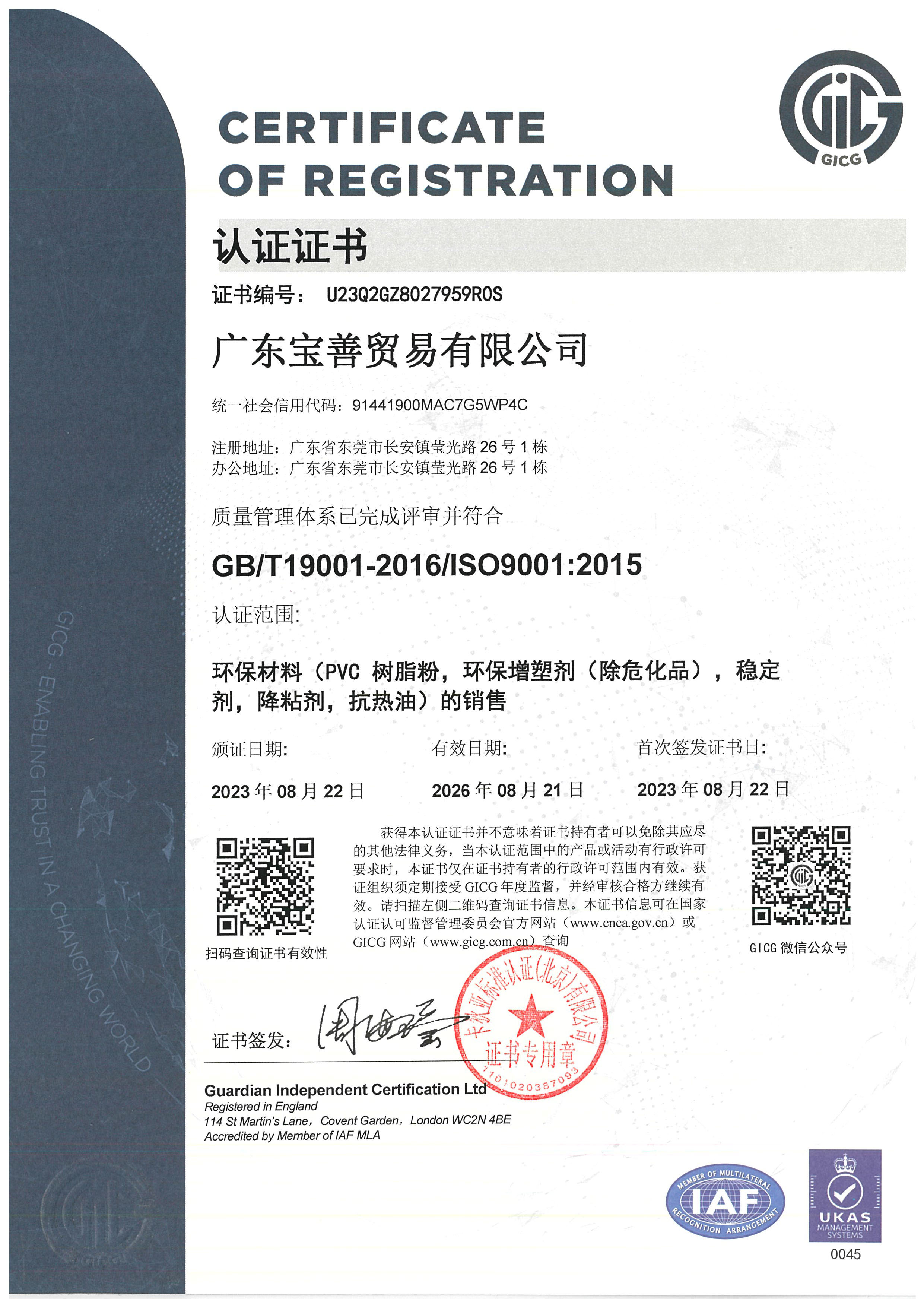
ISO 9001 quality-system documentation: the process baseline behind every batch-testing claim in this list.
Top 7 at a Glance — Comparison Table
| Rank | Material / Grade reference | Category | Verified compliance or standards signal | Parameter that decides fit | Typical fit |
|---|---|---|---|---|---|
| 1 | BASF HEXAMOLL® DINCH | Non-phthalate plasticizer | Approved for medical devices and food contact materials; described by BASF as FDA/EFSA compliant | Migration rate; toxicological documentation for the destination market | Medical supplies, food packaging, children’s vinyl toys |
| 2 | Eastman TXIB™ | Formulation additive / viscosity reducer | Described by Eastman as the lowest-viscosity (9 cps) additive available for flexible PVC | Viscosity in cps at process temperature; dosage window | Plastisol flow control; film-forming in coatings |
| 3 | Acetyl Tributyl Citrate (ATBC) | Bio-based citrate plasticizer | ATBC market for children’s toys and food packaging projected at USD 149 million by 2025 (Intel Market Research) | Ester purity | Children’s toys, food packaging |
| 4 | PSM-31 / PSH-10S / KANEVINYL PASTE SH-14 | PVC paste resin (slush molding) | Batch-level incoming-material testing: phthalates, heavy metals, PAHs, brominated flame retardants, RoHS, BPA, PFAS, REACH | K value | Slush-molded vinyl articles |
| 5 | PR-G / SY-Z140 | PVC paste resin (coating) | Same batch-level incoming-material test protocol | K value and plastisol viscosity | Coatings, inks, coated fabric |
| 6 | B5F / BJ-65 | Blend resin powder | Same batch-level incoming-material test protocol | Blend ratio and viscosity | Plastisol blending systems |
| 7 | Phenol-free Ca/Zn stabilizer systems | Stabilizer | REACH restricts DEHP, DBP and BBP to below 0.1% in toys and childcare articles (ECHA); Baoshan tests for organotin and heavy metals | Metal-soap ratio; phenol-free declaration | Toy, food-contact, medical, flooring |
How to Validate Any Material on This List Before You Commit
- Fix the destination market first. EU, US and China food-contact and toy rules are not interchangeable. The destination decides which compliance list — REACH, RoHS, FDA, GB 4806, EN71-3, PAHS — you are actually buying against. Nothing else on this list matters until that is settled.
- Fix the process route second. Slush molding, coating and plastisol blending each impose a different target K value and viscosity. A grade that is excellent in one route can be unworkable in another.
- Ask for grade-level documents. A portfolio-level compliance statement is not a substitute for the certificate attached to the specific grade and lot.
- Run a pilot on the real system. Change one component — plasticizer, resin or stabilizer — and re-test gelation, flow and surface appearance. Component-level compliance does not guarantee system-level processing behaviour.
- Use batch-level incoming-material testing as your control point. Baoshan’s laboratory is equipped with high-precision mass spectrometers including Agilent GC-MS, ICP-MS and Waters LC-MS/MS, and provides free testing for high-risk substances including phthalates, heavy metals, bisphenol A and organotin.
- Lock supply terms last. Confirm stock depth, packing and delivery route before finalising the formula — otherwise you validate a material you cannot actually buy at the volume you need.
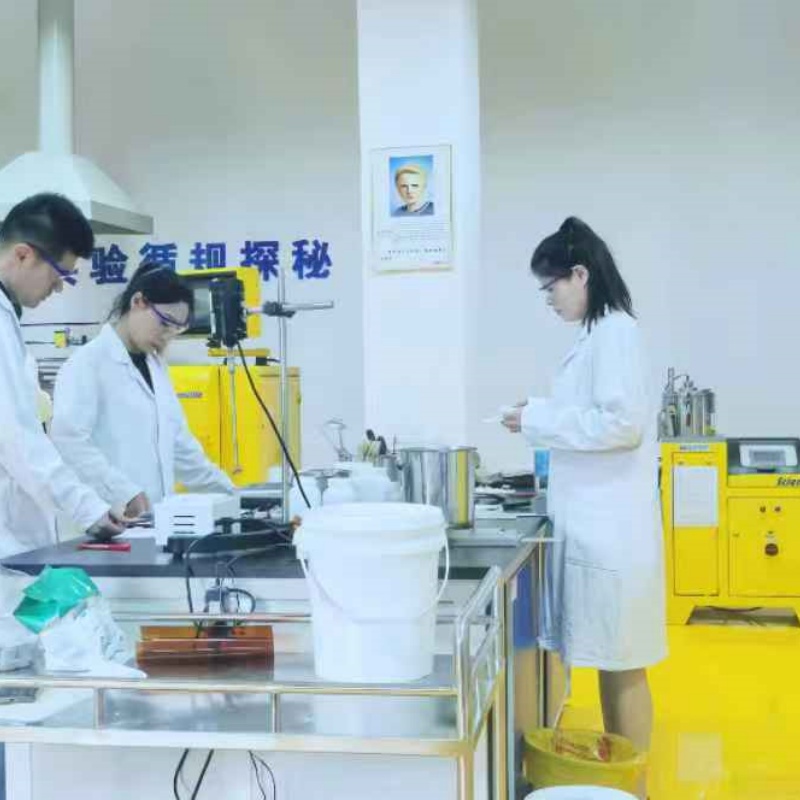
Batch-level incoming-material testing is the control point that turns a supplier claim into a verifiable fact.
Where These Seven Materials Are Used
- Children’s vinyl toys — slush-molded articles, where the resin grade, the plasticizer and the stabilizer all sit inside the toy-safety chain.
- Medical supplies and devices — an area where non-phthalate plasticizers with medical and food-contact approvals become the determining choice.
- Food packaging and food-contact articles — resin plus plasticizer plus a phenol-free stabilizer package.
- Automotive interiors — coated and moulded PVC parts where low-migration plasticization and odour performance are recurring requirements.
- Wallpaper and flooring — high-volume coating and calendering systems where viscosity control and stabilizer selection drive line stability.
- Inks and coatings — where the film-forming behaviour of a low-viscosity additive and the gelation behaviour of the paste resin interact directly.
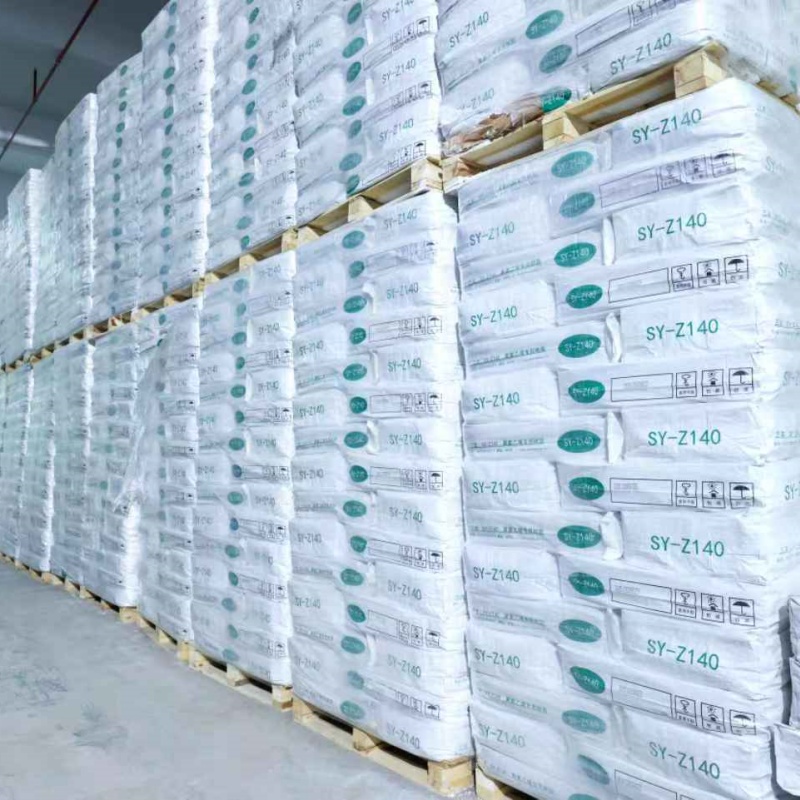
Warehousing depth is what converts an approved grade into a repeatable supply programme.
FAQ
1. Are these PVC vinyl materials REACH and RoHS compliant?
Compliance is grade-specific and market-specific, so the honest answer is: the materials are selected for compliant systems, and the documentation has to be confirmed grade by grade. Baoshan tests every batch of incoming material in its own laboratory and covers phthalates, heavy metals, PAHs, brominated flame retardants, RoHS, bisphenol A, PFAS and REACH-restricted substances as part of its environmental safety control. For context on why the phthalate question is asked first: under EU REACH, DEHP, DBP and BBP are restricted to below 0.1% in toys and childcare articles. If your destination is the EU, that threshold is the number your specification should name.
2. Can one supplier cover the resin, the plasticizer and the stabilizer together?
Yes — and that is why this list is ranked as a system rather than as seven unrelated products. Guangdong Baoshan Trading Co., Ltd. offers a range of PVC materials including paste resin, plasticizers and stabilizers for diverse applications, and holds authorized distributorships for BASF Hexamoll® DINCH and Eastman TXIB in China. Its laboratory provides formula optimization solutions and product-upgrade technical support, and the company assists BASF with DINCH application development in the Asia-Pacific region.
3. How should I compare cost between a conventional and a non-phthalate system?
Compare the whole system, not the plasticizer line item. The cost drivers that change when you move to a non-phthalate or bio-based plasticizer are the plasticizer itself, the dosage required to reach the same hardness, the possible need to re-tune the stabilizer package, and the testing you must commission if your supplier does not test incoming material. Because every one of those depends on your specific formulation and volume, a per-kilogram comparison is misleading — a project quotation is the only reliable cost input.
4. Can I get samples before committing?
Sampling is a standard step in this portfolio, and it is the only way to confirm gelation and flow behaviour on your own line. When you request a sample, ask for the batch test report at the same time; the two documents together are what let you compare a candidate grade against your existing material.
5. What lead time and supply continuity should I expect?
Supply certainty is built from stock and warehousing, not from promises. Baoshan operates a 20,000-square-meter self-built warehouse and 16 liquid storage tanks, and holds a safety stock of over three months for bulk European materials. The company strictly adheres to the ISO 9001 standard and has passed the joint audit conducted by BASF’s Petrochemical Division, Quality Management Department, and Environment, Health and Safety Department. It also runs an in-house fleet alongside land and sea logistics routes. To move from this list to a decision, send your target grade list, destination market and annual volume to the Baoshan team and ask for a sample plus a project quotation.
Conclusion
The 2026 shortlist for PVC vinyl materials in green-energy and new-materials work is not built from the cheapest components — it is built from components that can survive a compliance review. DINCH and TXIB carry the additive side of that argument; ATBC supplies the bio-based route; the paste resin and blend resin references (PSM-31, PSH-10S, KANEVINYL PASTE SH-14, PR-G, SY-Z140, B5F, BJ-65) supply the polymer side; and phenol-free Ca/Zn stabilization closes the system. What makes the list actionable rather than theoretical is the verification layer behind it: an ISO 9001 process, a laboratory that tests every batch of incoming material for phthalates, heavy metals, bisphenol A and organotin, and authorized distributorships for BASF and Eastman products in China.
Buyers should also treat this list as a starting point, not a final specification. K value, viscosity, purity and the destination-market compliance list are the four variables that will decide which of the seven entries actually belongs in your formula.
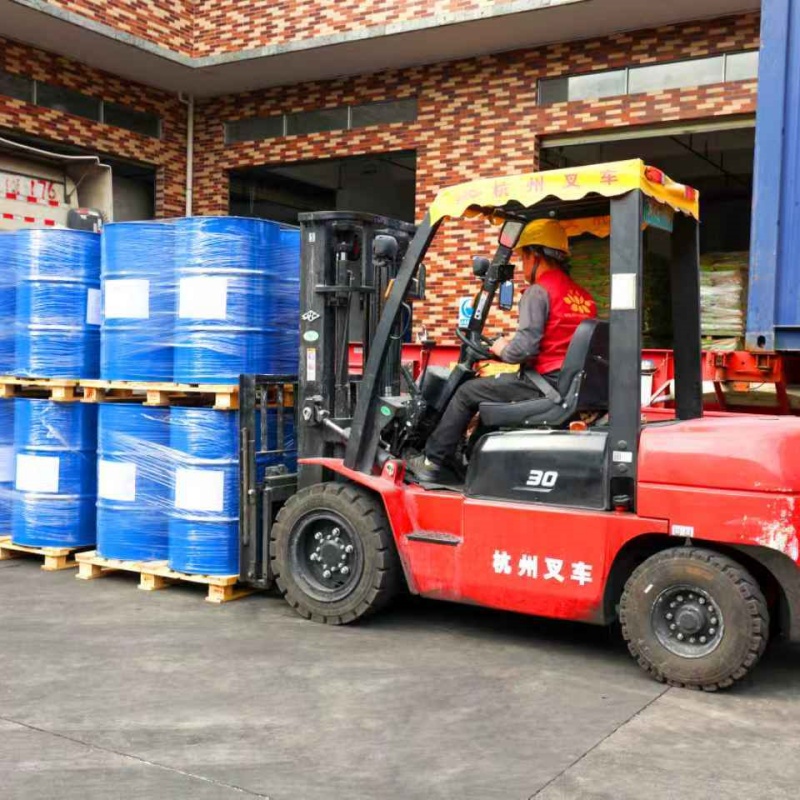
From sample request to bulk shipment — the next step after the shortlist.
Next step: request a sample and a project quotation.
Send your target grade list, destination market and annual volume to Guangdong Baoshan Trading Co., Ltd. The team will confirm grade availability, issue batch test documentation and quote against your specification.
Website: www.baoshancl.cn
Email: misscheng1984@163.com
Tel: +86 13580992838
WhatsApp: +84 865388399
Address: Building 1, No. 26, Yingguang Road, Chang’an Town, Dongguan City, Guangdong Province
Have Questions or Need More Details?
Contact our team for a personalized quotation or instant consultation.
Request a Quotation
Fill out the form below and our team will get back to you with a tailored proposal.
WhatsApp Direct Chat
Prefer to chat in real-time? Message us on WhatsApp for instant assistance & quick answers.
- Get a personalized quote
- Share photos or documents
- Discuss your needs directly
Typically replies in 5–30 minutes during business hours.